
In the world of men’s fragrance, few categories evoke as much sophistication, depth, and timeless appeal as the oriental woody fragrance for men. This distinctive scent family represents a perfect marriage between two of perfumery’s most compelling traditions: the warm, sensual richness of oriental accords and the natural, grounding presence of woody notes.
For the modern man seeking a signature scent that communicates confidence, sophistication, and subtle power, understanding the oriental woody fragrance category is essential. This comprehensive 2800-word guide serves as your definitive resource, exploring every aspect of this captivating scent family from its historical roots to practical wearing advice. Whether you’re searching for a oriental woody fragrance for men or simply want to understand what does oriental woody fragrance mean, we provide the insights needed to navigate this rich olfactory landscape with confidence and discernment.
Understanding the Category: What Is an Oriental Woody Fragrance?
Before exploring specific scents, it’s crucial to define the category itself: What is an oriental woody fragrance? According to fragrance classification systems used by perfumers and organizations like The Fragrance Foundation, an oriental woody fragrance represents a hybrid category that combines elements from both the Oriental and Woody fragrance families.
The Fragrance Family Breakdown
The oriental woody fragrance category sits at the intersection of two primary scent families:
- Oriental Family: Characterized by warmth, sweetness, and sensuality. These fragrances typically feature notes like vanilla, amber, resins, and spices. As noted in The Fragrance Foundation’s classification guide, oriental scents are often described as “voluptuous,” “exotic,” and “lingering.”
- Woody Family: Defined by dry, natural, and often aromatic qualities. These scents feature notes like sandalwood, cedar, vetiver, patchouli, and modern synthetic woods. According to resources like Basenotes, woody fragrances convey “strength,” “stability,” and “natural sophistication.”
When these families merge, they create the oriental woody fragrance profile—a scent that’s simultaneously warm and dry, sweet and earthy, sensual and grounding. This balance makes it one of the most versatile and compelling categories in men’s perfumery.
Historical and Cultural Context
The oriental woody fragrance tradition has deep roots in both Eastern and Western perfumery practices:
- Eastern Influence: The use of precious woods like oud (agarwood), sandalwood, and cedar in Middle Eastern and Asian fragrance traditions dates back centuries. These were often combined with resins like frankincense and myrrh, creating early prototypes of what we now call oriental woody perfumes.
- Western Evolution: In the 20th century, Western perfumers began incorporating these exotic materials into their creations, leading to iconic fragrances that defined the masculine oriental woody fragrance category. Houses like Guerlain, Yves Saint Laurent, and more recently, niche brands like Tom Ford and Creed, have all contributed to evolving this category.
Today, the oriental woody fragrance meaning encompasses everything from traditional compositions to modern interpretations that use innovative aroma chemicals to create new variations on this timeless theme.
The Olfactory Experience: What Does an Oriental Woody Fragrance Smell Like?
This is the fundamental question for anyone exploring this category: What does an oriental woody fragrance smell like? The experience is rich, complex, and deeply satisfying.
Core Characteristics of Oriental Woody Scents
A true oriental woody fragrance typically exhibits these key characteristics:
- Warmth: An inherent warmth that comes from amber, vanilla, or resinous notes. This isn’t spicy heat but rather a comforting, radiant warmth.
- Dryness: A dry quality from woods and often incense or vetiver that balances any sweetness.
- Depth: Multiple layers that reveal themselves over time, creating a sophisticated wearing experience.
- Longevity: These fragrances tend to be longer-lasting due to the tenacity of both oriental and woody materials.
- Complexity: Rarely simple or linear, they evolve significantly from application to dry-down.
The Sensory Journey
When you experience a quality oriental woody scent, you’ll typically notice:
- The Opening: Often features spices (cardamom, saffron, pepper) or bright citrus notes that provide initial energy before the deeper notes emerge.
- The Heart: Reveals the core personality—warm amber meets dry woods, sometimes with floral or herbal bridges.
- The Dry-Down: The final, lingering impression where rich woods and smooth amber/vanilla create a sophisticated, skin-scent that can last for hours or even days on clothing.
As fragrance expert and author Luca Turin notes in “Perfumes: The A-Z Guide,” the best oriental woody fragrances create “a perfect balance between sweet warmth and dry austerity,” making them particularly compelling for masculine perfumery.
Key Notes and Ingredients: Building Blocks of Oriental Woody Fragrances
Understanding the oriental woody fragrance characteristics requires familiarity with the key notes that define this category.
Oriental Notes (The Warmth)
| Note Category | Common Notes | Olfactory Character | Role in Oriental Woody Scents |
|---|---|---|---|
| Amber Notes | Labdanum, Benzoin, Vanilla | Warm, sweet, resinous, sometimes powdery | Provides the foundational warmth and sensuality. Creates the “oriental” character. |
| Spicy Notes | Cardamom, Saffron, Cinnamon, Nutmeg | Warm, aromatic, sometimes pungent | Adds complexity and energy. Bridges between top and base notes. |
| Resinous Notes | Frankincense, Myrrh, Opoponax | Smoky, balsamic, meditative | Adds depth and spiritual/meditative quality. Enhances longevity. |
| Vanilla Notes | Madagascar Vanilla, Tahitian Vanilla | Sweet, creamy, comforting | Softens woody edges. Adds universal appeal and wearability. |
Woody Notes (The Structure)
| Note Category | Common Notes | Olfactory Character | Role in Oriental Woody Scents |
|---|---|---|---|
| Oud Notes | Agarwood (real or synthetic) | Dark, medicinal, leathery, complex | Adds exotic luxury and depth. Modern synthetic ouds are cleaner and more wearable. |
| Sandalwood Notes | Mysore Sandalwood, Australian Sandalwood | Creamy, milky, soft, woody | Provides smooth, comforting woodiness. Acts as a bridge between other notes. |
| Cedarwood Notes | Atlas Cedar, Virginia Cedar | Dry, pencil-shaving, aromatic | Adds clean, dry structure. Prevents composition from becoming too sweet or heavy. |
| Patchouli Notes | Indonesian Patchouli, Clean Patchouli | Earthy, chocolatey, sometimes minty | Adds earthy depth and modernity. Modern versions are cleaner and less hippie-associated. |
| Vetiver Notes | Haitian Vetiver, Indonesian Vetiver | Dry, grassy, smoky, rooty | Provides dry, aromatic counterpoint to sweet oriental notes. |
How These Notes Combine
The magic of a successful oriental woody perfume lies in how these elements are balanced. Too much oriental sweetness without enough woody dryness becomes cloying. Too much woody austerity without oriental warmth becomes cold and uninviting. The perfect oriental woody fragrance finds equilibrium between these poles.
The Masculine Appeal: Why Oriental Woody Fragrances Work for Men
A natural question arises: What makes the oriental woody fragrance masculine particularly effective for men? Several factors contribute to this category’s strong masculine associations.
Psychological and Cultural Factors
- Depth and Complexity: These fragrances mirror the psychological complexity often culturally associated with mature masculinity—they’re not simple or one-dimensional.
- Warmth Without Sweetness: The warmth comes from amber and resins rather than fruity or floral sweetness, aligning with traditional masculine scent preferences.
- Natural Elements: The prominent wood notes connect to primal, natural associations that have masculine connotations in many cultures.
- Confidence and Presence: As noted in discussions on fragrance communities like Reddit’s r/fragrance, oriental woody scents are often described as “confidence in a bottle”—they have presence without being loud.
Evolutionary Perspective
From an evolutionary psychology standpoint, some researchers suggest that warmer, woodier scents may subconsciously communicate stability, resource access (precious woods and resins were historically valuable commodities), and maturity—traits often associated with masculine attractiveness.
However, it’s important to note that fragrance preference is highly personal, and the best masculine oriental woody fragrance is one that makes the individual wearer feel confident and authentic.
Seasonal Suitability: Best Season for Oriental Woody Fragrance
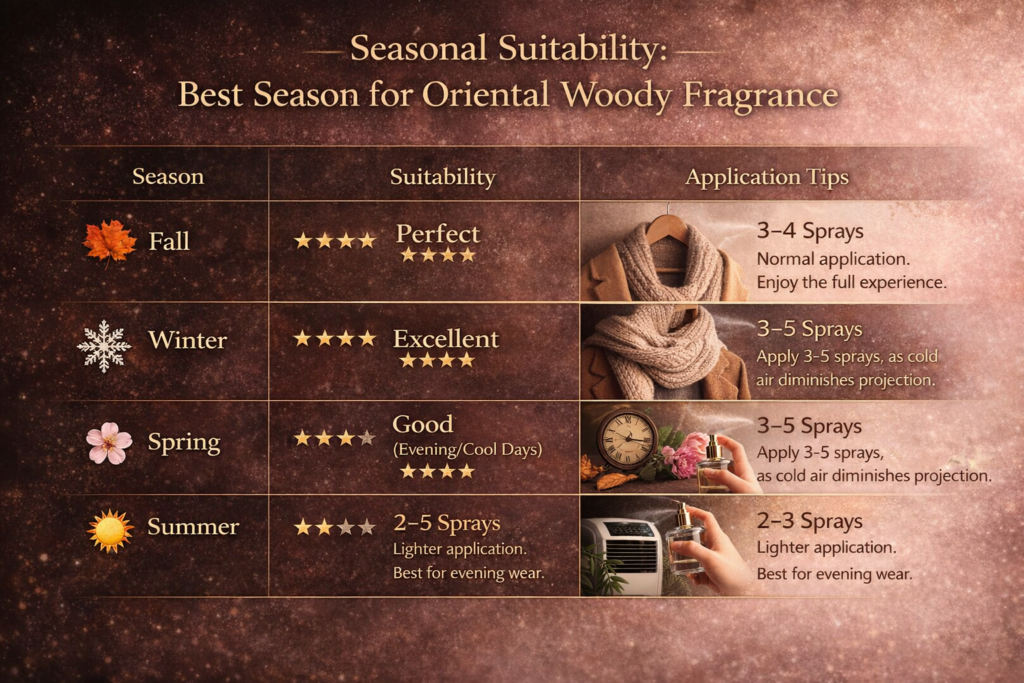
One of the most practical considerations is seasonal wearing: What is the best season for oriental woody fragrance?
Seasonal Performance Analysis
| Season | Suitability | Reasoning | Application Tips |
|---|---|---|---|
| Fall | Perfect | Cooling temperatures complement the warmth. Crisp air carries the scent beautifully. Falling leaves vibe matches woody notes. | 3-4 sprays normal application. Enjoy the full experience. |
| Winter | Excellent | Cold weather needs substantial scents. Warmth provides psychological comfort. Coats and layers hold scent well. | 3-5 sprays, as cold air diminishes projection. Apply to clothing for longevity. |
| Spring | Good (Evening/Cool Days) | Cool spring evenings work well. Might be too heavy for warm spring days. Transitional weather matches the balance. | 2-3 sprays, lighter application. Best for evening wear. |
| Summer | Selective (Evenings/AC) | Can be overwhelming in heat/humidity. Evenings or air-conditioned settings work. Some modern interpretations are summer-adapted. | 1-2 sprays max. Apply to cooler body areas. Consider lighter concentrations (EDT vs EDP). |
The Ideal Conditions
Through testing and community consensus on platforms like Fragrantica and Basenotes, oriental woody fragrances perform best in temperatures between 50-70°F (10-21°C). In these conditions, the complexity unfolds optimally without becoming overwhelming.
Special note on summer: While traditional oriental woody perfume might be challenging in summer, some modern interpretations use lighter woods (cedar, vetiver) and less sweet amber, creating what some call “summer orientals” or “woody freshies” that work year-round.
Occasion and Setting: When to Wear Oriental Woody Fragrances
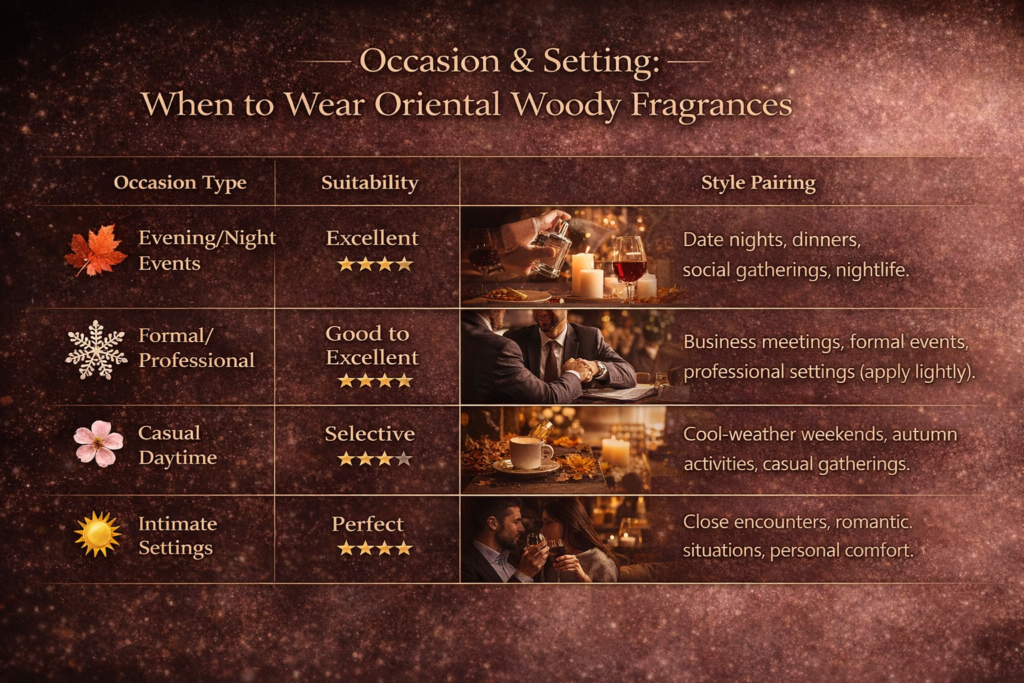
Beyond seasons, understanding appropriate occasions enhances your wearing experience.
Ideal Settings for Oriental Woody Scents
| Occasion Type | Suitability | Reasoning | Style Pairing |
|---|---|---|---|
| Evening/Night Events | Excellent | Lower temperatures. Romantic/social settings. Scents bloom in night air. | Date nights, dinners, social gatherings, nightlife. |
| Formal/Professional | Good to Excellent | Projects sophistication and confidence. Many are office-appropriate with light application. | Business meetings, formal events, professional settings (apply lightly). |
| Casual Daytime | Selective | Depends on specific fragrance and weather. Lighter interpretations work better. | Cool-weather weekends, autumn activities, casual gatherings. |
| Intimate Settings | Perfect | Creates personal scent bubble. Warm, comforting quality. | Close encounters, romantic situations, personal comfort. |
The Versatility Spectrum
Not all oriental woody fragrances are created equal in terms of versatility. Some guidelines:
- More Versatile: Those with prominent cedar, vetiver, or clean patchouli alongside amber.
- More Specialized: Those with heavy oud, strong incense, or very sweet amber—better saved for evening or cooler weather.
- Modern vs. Traditional: Modern interpretations tend to be more versatile across occasions than traditional ones.
Performance Characteristics: What to Expect
A key consideration for any fragrance buyer is performance. Here’s what typically characterizes oriental woody fragrance longevity and related factors.
Performance Metrics
| Performance Aspect | Typical Range | Factors Influencing Performance |
|---|---|---|
| Longevity | 8-12+ hours on skin | Concentration (Parfum/EDP last longer). Ingredient quality. Specific notes (oud, patchouli, amber are tenacious). |
| Projection | Moderate to Strong | First 3-4 hours strongest. Then settles closer to skin. Concentration and specific composition affect this. |
| Sillage | Moderate to Heavy | Leaves noticeable trail, especially in first hours. Better in cool/dry air than hot/humid. |
| Evolution | Significant | Typically evolves through distinct phases. Dry-down often differs markedly from opening. |
Maximizing Performance
To get the most from your oriental woody scent:
- Moisturize First: Apply unscented lotion to dry skin before fragrance. Hydrated skin holds scent better.
- Pulse Points: Apply to warm areas (wrists, neck, chest) for optimal diffusion.
- Clothing Application: A light spray on clothing (test first) can extend longevity dramatically.
- Storage: Keep in cool, dark place away from sunlight and temperature fluctuations to preserve integrity.
How to Choose the Right Oriental Woody Fragrance for You
With hundreds of options available, selecting the right oriental woody fragrance for men can be daunting. This decision framework can help.
Step-by-Step Selection Guide
- Identify Your Preference Spectrum:
- More Oriental: Sweeter, warmer, more amber/vanilla focused.
- More Woody: Drier, earthier, more wood/incense focused.
- Balanced: Equal parts warmth and dryness.
- Consider Your Climate:
- Cool/Cold Climate: Can handle richer, sweeter, heavier compositions.
- Warm/Hot Climate: Look for lighter woods (cedar, vetiver) and less sweet amber.
- Define Your Use Case:
- Daily Wear: Seek versatility and moderate projection.
- Special Occasion: Can opt for more dramatic, less versatile scents.
- Set Your Budget:
- Designer: $50-150, generally more accessible/mass-appealing.
- Niche: $150-400+, more unique/artistic compositions.
- Luxury: $400+, exceptional materials and craftsmanship.
Sampling Strategy
Before committing to a full bottle:
- Get Decants/Samples: Many online retailers offer small samples (2ml-5ml).
- Test on Skin: Fragrances react with body chemistry. Test on your skin, not just paper.
- Wear Multiple Times: Some scents need multiple wears to appreciate fully.
- Consider All Seasons: If possible, test in different weather conditions.
Top Recommended Oriental Woody Fragrances by Subcategory
Based on community consensus across Fragrantica, Basenotes, and Reddit’s r/fragrance, here are some highly regarded options:
Designer Classics (Accessible & Mass-Appealing)
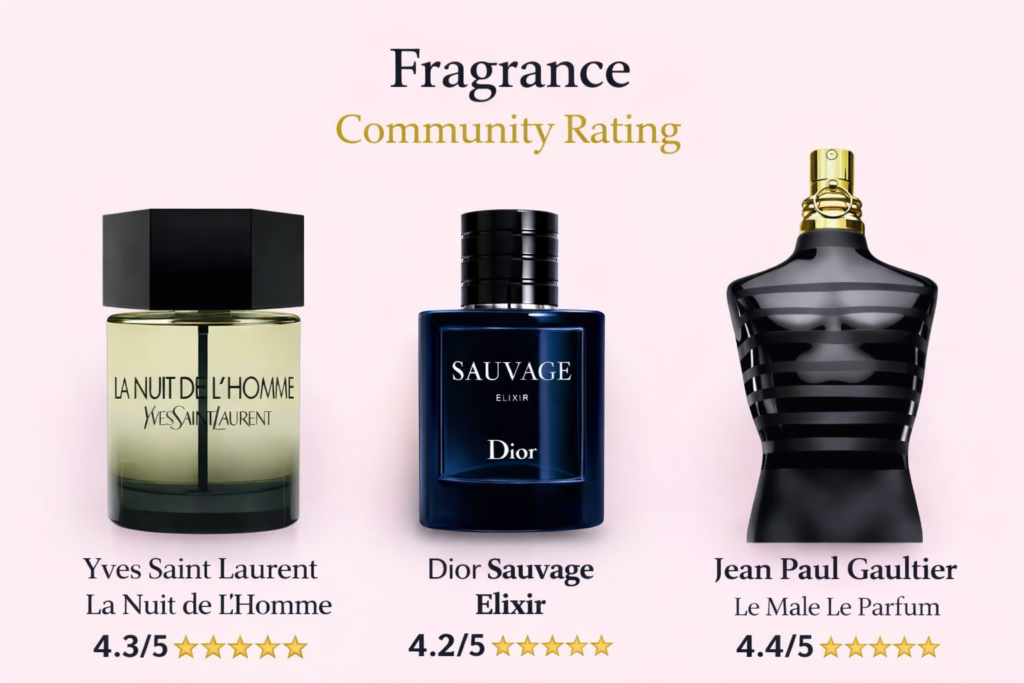
| Fragrance | Key Notes | Best For | Community Rating |
|---|---|---|---|
| Yves Saint Laurent La Nuit de L’Homme | Cardamom, Cedar, Vetiver | Evening wear, romantic settings | 4.3/5 |
| Dior Sauvage Elixir | Sichuan Pepper, Ambroxan, Licorice | Modern masculine, all-season versatility | 4.2/5 |
| Jean Paul Gaultier Le Male Le Parfum | Cardamom, Vanilla, Cedar | Sweet oriental woody, cooler weather | 4.4/5 |
Niche Standouts (Unique & Artistic)
| Fragrance | Key Notes | Best For | Community Rating |
|---|---|---|---|
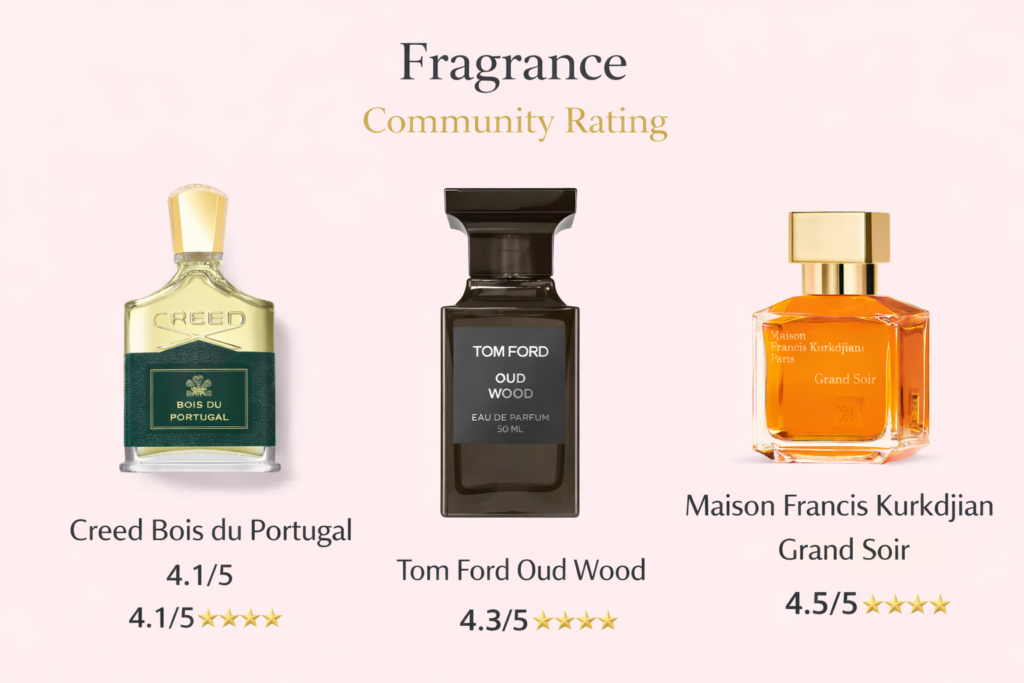
| Creed Bois du Portugal | Sandalwood, Vetiver, Lavender | Classic sophistication, formal occasions | 4.1/5 |
| Tom Ford Oud Wood | Oud, Sandalwood, Cardamom | Modern luxury, signature scent potential | 4.3/5 |
| Maison Francis Kurkdjian Grand Soir | Amber, Vanilla, Benzoin | Pure oriental warmth with woody base | 4.5/5 |
Modern Interpretations (Innovative Approaches)
| Fragrance | Key Notes | Best For | Community Rating |
|---|---|---|---|
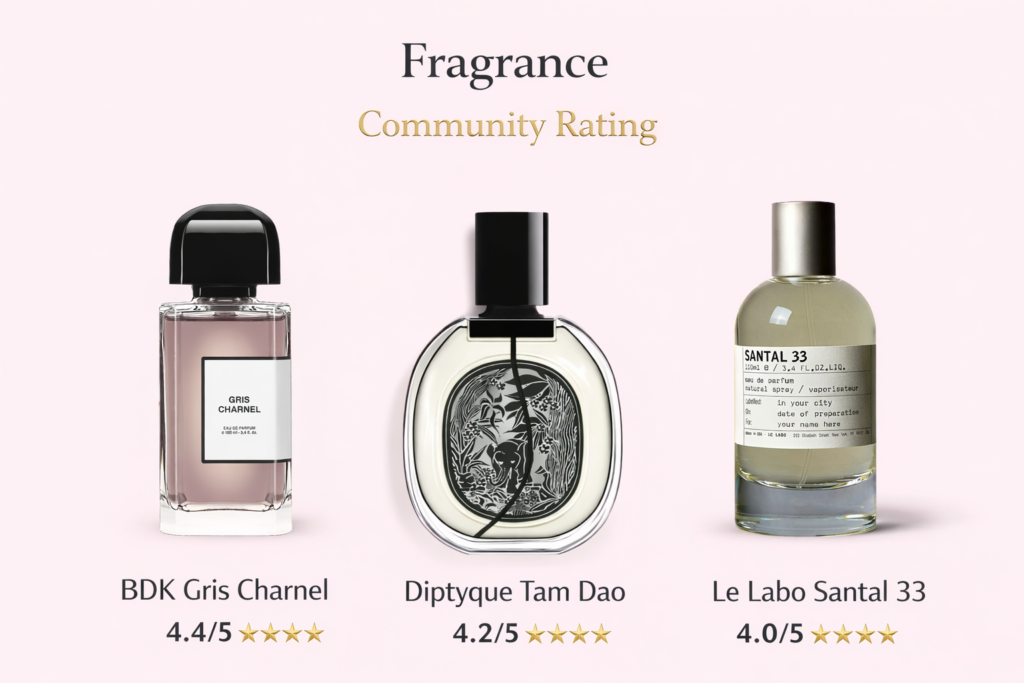
| BDK Gris Charnel | Cardamom, Fig, Sandalwood | Unisex appeal, modern minimalist | 4.4/5 |
| Diptyque Tam Dao | Sandalwood, Cedar, Amyris | Woody-focused with subtle oriental warmth | 4.2/5 |
| Le Labo Santal 33 | Sandalwood, Cardamom, Violet | Modern iconic, distinctive signature | 4.0/5 |
Frequently Asked Questions (FAQ)
Q1: What’s the difference between oriental woody and just woody fragrances?
A: Woody fragrances focus primarily on dry wood notes (cedar, vetiver, sandalwood) with minimal sweetness. Oriental woody fragrances combine these woods with warm, sweet, or resinous oriental notes (amber, vanilla, incense), creating a warmer, more sensual experience.
Q2: Are oriental woody fragrances only for older men?
A: Absolutely not. While some traditional examples have mature associations, many modern interpretations are worn by men of all ages. The key is finding a fragrance that matches your personal style and confidence level.
Q3: How many sprays of an oriental woody fragrance should I use?
A: Start with 2-3 sprays (wrists and neck/chest). These are typically potent fragrances. You can adjust based on specific fragrance strength and occasion. In office settings, err on the side of less.
Q4: Can oriental woody fragrances be worn in summer?
A: Selectively. Look for ones with prominent vetiver, cedar, or fresh spices rather than sweet amber or vanilla. Apply minimally and to cooler body areas. Evening summer wear works better than daytime.
Q5: Why do oriental woody fragrances typically cost more?
A: Many contain expensive natural ingredients (real sandalwood, oud, certain ambers) or complex synthetic alternatives. Their concentration is often higher (EDP or Parfum), and development can be more involved due to balancing multiple strong notes.
Q6: How do I store these fragrances to maximize their lifespan?
A: Keep in original box if possible. Store in cool, dark place (not bathroom). Avoid temperature fluctuations. Properly stored, most will maintain integrity for 3-5 years or more.
Q7: Are there any skin types that don’t work well with oriental woody fragrances?
A: Those with very dry skin might find longevity reduced—moisturize first. Some people’s skin chemistry amplifies sweetness or woodiness unpredictably—always test on your skin before buying.
Conclusion: The Enduring Appeal of Oriental Woody Fragrances
The oriental woody fragrance for men represents one of perfumery’s most sophisticated and enduring categories. Its appeal lies in its perfect balance of opposing qualities: warmth and dryness, sensuality and austerity, exoticism and familiarity. For the modern man, a well-chosen oriental woody perfume can serve as more than just a scent—it can be a signature, a confidence boost, and a subtle form of self-expression.
As you explore this rich category, remember that the best fragrance is one that resonates with you personally. Whether you’re drawn to the deep oriental woody fragrance tradition or prefer modern oriental woody fragrance innovations, the journey of discovery is part of the pleasure. Sample widely, trust your nose, and don’t be afraid to wear what truly makes you feel like your best self.
In a world of fleeting trends, the oriental woody scent stands as a testament to timeless sophistication—a category that has evolved over centuries but never lost its essential power to captivate, comfort, and communicate depth of character.
External Resources & Further Reading:
- For comprehensive fragrance database and community reviews, visit Fragrantica, an essential resource for understanding specific fragrances within the oriental woody category.
- To explore detailed fragrance education and classification systems, refer to The Fragrance Foundation’s resources on fragrance families and notes.
- For community discussions, recommendations, and personal experiences with oriental woody fragrances, Reddit’s r/fragrance community offers valuable real-world perspectives.
- To understand the historical and cultural context of woody and oriental materials, resources like Basenotes provide in-depth articles and forums.
- For scientific perspective on fragrance materials and perception, publications like The Good Scents Company offer technical information on aroma chemicals and natural materials.
Disclaimer: This article is an educational guide created for informational purposes. Fragrance descriptions are subjective experiences based on general consensus and expert sources. Individual experiences with specific fragrances may vary based on body chemistry, batch variations, and personal perception. Always test fragrances on your skin before purchasing when possible. The author is not affiliated with any fragrance houses or retailers mentioned. Prices, availability, and formulations are subject to change.